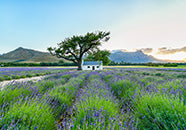



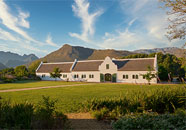

While the bounty of summer with lush green vineyards and age-old, shade-providing oaks, is the image predominantly associated with the Cape Winelands, it is when we are confronted with the stripped winter landscape that we are often struck by the unexpected beauty of the naked vines and bare oak tree branches against the stark white of the Cape Dutch architecture. Without summer’s foliage and soft greens, the curvilinear gables, elegant symmetry, whitewashed walls and thatched roofs suddenly offer a new perspective.
The same might be true in nature. While winemakers and viticulturists would tell you about the importance of winter dormancy in the vineyards, they’ll also be the first to agree that what is often see as winter’s “absence”, is rather a season filled with transformation and renewal. Hurrying out of the rain or cold, we might often miss winter’s qualities and rhythms taking place among the trees.
And this is the inspiration for the latest art exhibition in the La Motte Ateljee.
Opening on 4 July, Among the Trees takes the interval between winter and spring as its point of departure, bringing together a group of South African artists working across painting, ceramics, sculpture, textiles, installation, sound, and material experimentation. The exhibition considers how the surrounding natural world is encountered, interpreted, and translated through artistic practice. Rather than presenting nature as a passive subject for representation, the participating artists engage with it as material, collaborator and source. Their works emerge from processes of observation, collection, memory, and transformation, shaped by encounters with the environments they inhabit.
Among the Trees suggests more than a physical location, but rather a distinctive position within both landscape and cultural imagination. Trees are markers of time, witnesses to environmental change, repositories of memory, and points of orientation within broader ecological systems. To stand among trees is to become aware of temporal scales that exceed human experience. Growth, decay, dormancy, and renewal unfold according to rhythms that continue regardless of human observation. Trees remind us that change is often gradual, cumulative, and difficult to perceive in the moment.
In this sense, Among the Trees is less concerned with landscape as scenery and more with the idea of landscape as a way of thinking. The exhibition proposes that meaningful engagement with the natural world begins through acts of attention. Across diverse materials and approaches, the participating artists invite viewers to slow down, observe more carefully, and consider the relationships that connect people, objects, environments, and seasons. (See more information on artists and works on exhibition in Notes to Editor.)
In Among the Trees, the landscape emerges not as a fixed image but as a layered and evolving experience that can be seen, touched, heard, tasted, remembered, and imagined and guests are invited to an immersive experience that extends beyond visual experience through a series of exciting workshops and interdisciplinary collaborations that explore alternative ways such as taste and sound to encounter the landscape.
Among the Trees opens in the La Motte Ateljee on 4 July.
Artists and works on exhibition:
Artists: Adéle Sherlock | Barbara Wildenboer | Casamento | Catherine Holtzhausen | Chloë Wallace | Conrad Oosthuizen | Cup Classique | Dayna-Gay Tate | Jan Ernst | Jaco van Schalkwyk |
J.M. Otto | Usha Seejarim
Gathering botanical specimens from her immediate surroundings, Chloë Wallace uses impressions of leaves, feathers and insect wings to create delicate ceramic forms that function as records of fleeting encounters. Adéle Sherlock explores similar concerns through her unglazed porcelain vessels, drawing inspiration from organic patterns and natural cycles. In contrast, the bold forms, material weight, and a strong sculptural presence of the works by Jan Ernst occupy space with confidence and authority rather than intimate encounters and fragile traces.
The relationship between material and artist is central to the practice of J.M. Otto, whose paintings are created using pigments derived directly from earth and trees. Barbara Wildenboer's sculptural works similarly explore connections between material and meaning, combining various types of wood with porcelain elements in intricate structures that reflect on systems of interdependence within the natural world. Rather than sourcing raw materials directly from nature, Usha Seejarim works with existing objects of organic origin that tell stories of everyday use. Catherine Holtzhausen and Starry-Eve Collett of Casamento both embrace processes that demand patience and precision with detailed botanical embroidery and hand-painted and cut paper collages. Paintings by Dayna-Gay Tate and Jaco van Schalkwyk both engage with landscape but in contrasting ways – juxtaposing observation and memory.
Translating visual language into taste, the artisan teas of Cup Classique interpret Jaco van Schalkwyk's painting Nothing Returned, through flavour. A sound installation by Conrad Oosthuizen operates alongside the artworks as an independent yet related presence. Generated through the translation of botanical data into sound, the work proposes that landscapes communicate through rhythms, vibrations, and frequencies that often remain beyond ordinary perception.